Signs of Feline Friendship
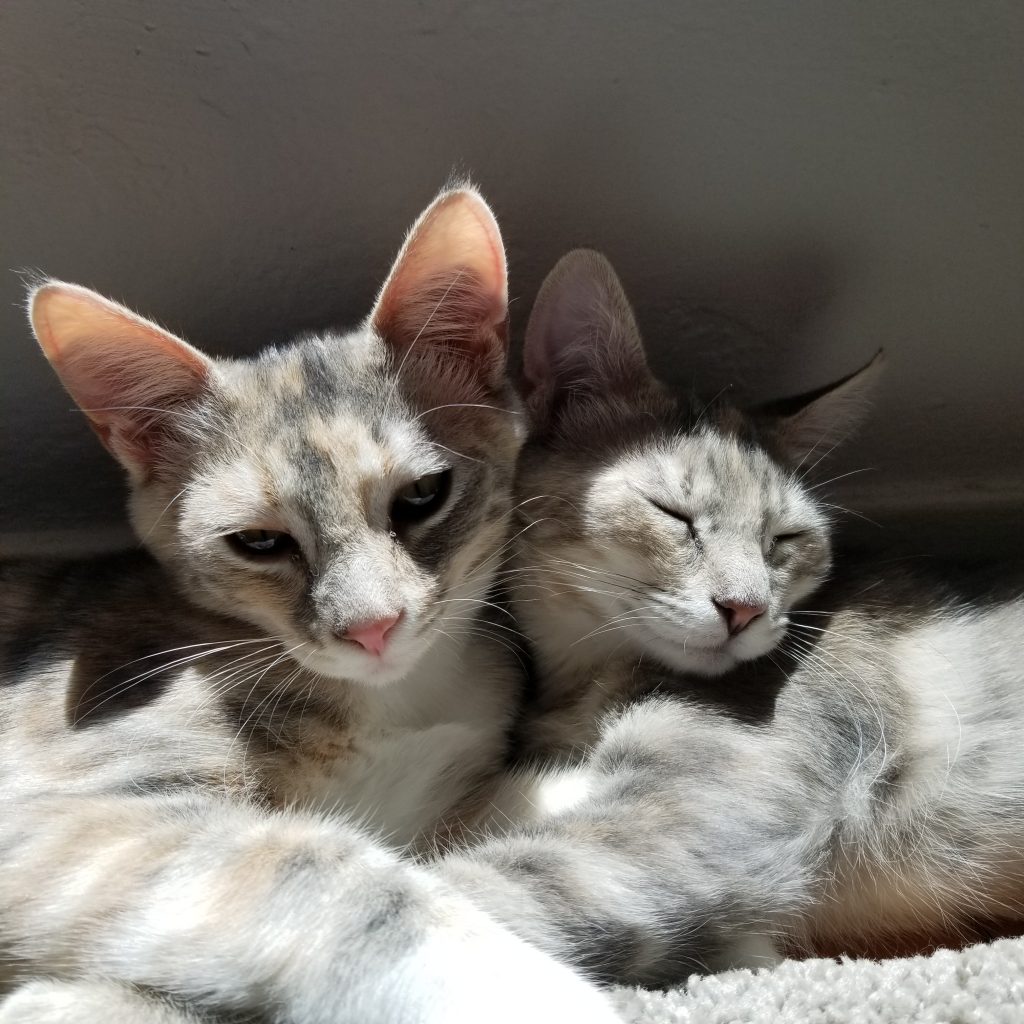
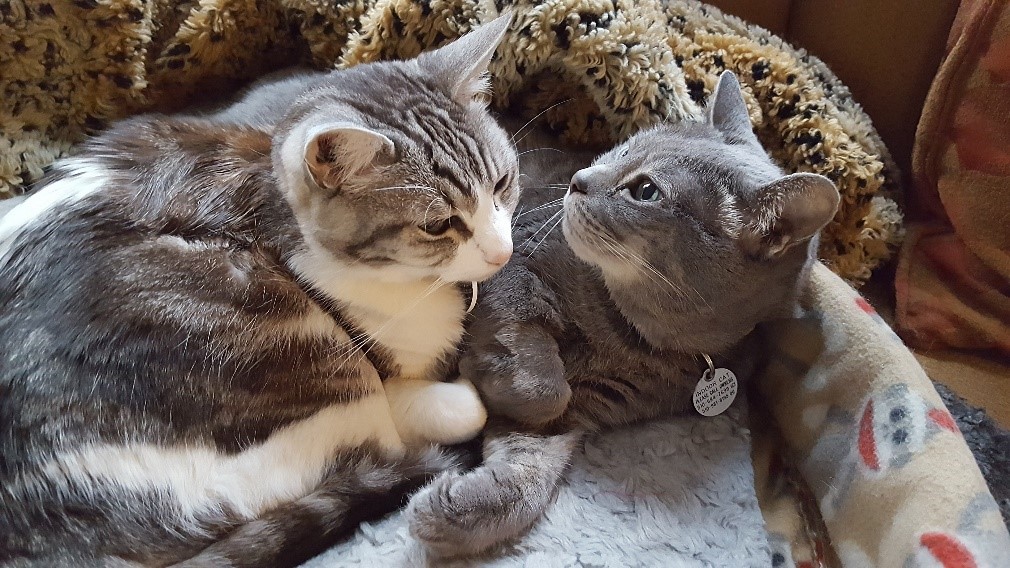
You may be familiar with the signs of feline friendship, behaviors associated with cats who known in the scientific literature as “preferred associates.” Cats who are friends:
- are often found close together (within a few feet)
- use each other as a “pillow” (lie in physical contact)
- nose touch each other
- groom and rub against one another (known as allogrooming and allorubbing, respectively)
- approach each other with tails up
- play together
If you know anything about cats, you probably also know that almost nothing about them is straight-forward. This includes (especially!!) their social interactions. In addition to the scant research on cat social behavior, there are a lot of misconceptions about cats that persist. Classic example: we cat experts have spent decades trying to debunk myths about “alpha cats” and dominance. While humans love hierarchies, cats not so much. Yet the myth persists!
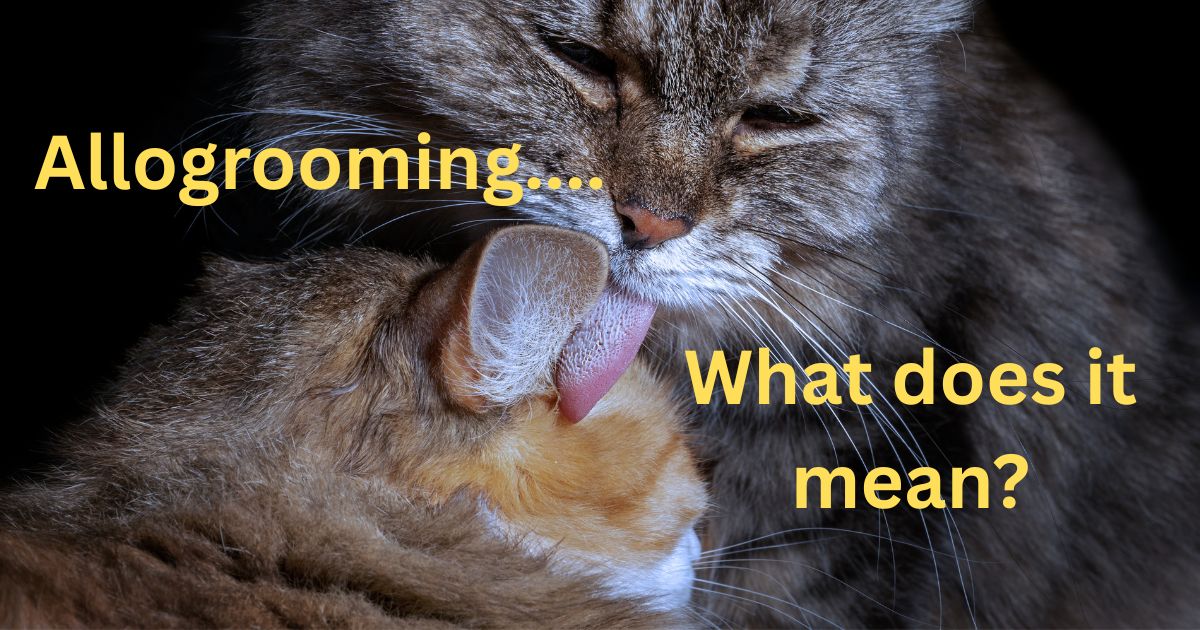
Allogrooming: When cats lick each other
This is why we need new research to make us question everything we know! That includes a new study about allogrooming in cats! Allogrooming is almost always described as a sign of feline friendship (see list above). Animals of many different species groom each other and it is assumed that there are many benefits to allogrooming, including removing parasites, and reducing stress (who doesn’t enjoy a little spa day?). In cats, allogrooming is assumed to help maintain a “group scent” that facilitates social bonding.
But – if cats who are friends tend to groom each other, is the opposite true? Are cats who groom each other usually friends? One 1998 study of 25 cats living in a laboratory suggested that allogrooming resulted in agonistic behaviors such as hissing, flattened ears, tail lashing, or swatting the other cat over a third of the time it occurred! Yet this particular study has received little attention.
Almost 30 years later, a new study, “Unravelling feline social dynamics – A video-based observational study on allogrooming in domestic cats,” was recently published in Applied Animal Behaviour Science.
What did the researchers do?
The researchers had a few goals:
- to see which parts of the body cats tend to groom on themselves or each other
- to see what behaviors tend to occur along with allogrooming
- to see if there were any cat characteristics that might explain grooming between cats
The researchers surveyed 312 caregivers who had two cats, to get information about the cats and their social interactions. The researchers followed up with 163 participants, asking them to send videos of their cats interacting. Of the videos received, 53 included good-quality footage of cats grooming each other. The videos were assessed for behaviors within four categories:
- Communication and interaction (e.g., grooming, physical contact, sniffing, vocalizing)
- Postures and movements (e.g., moving toward or away from each other, wrestling)
- Ear position
- Tail movement
Videos from the study can be watched here: https://osf.io/4fpmn/overview
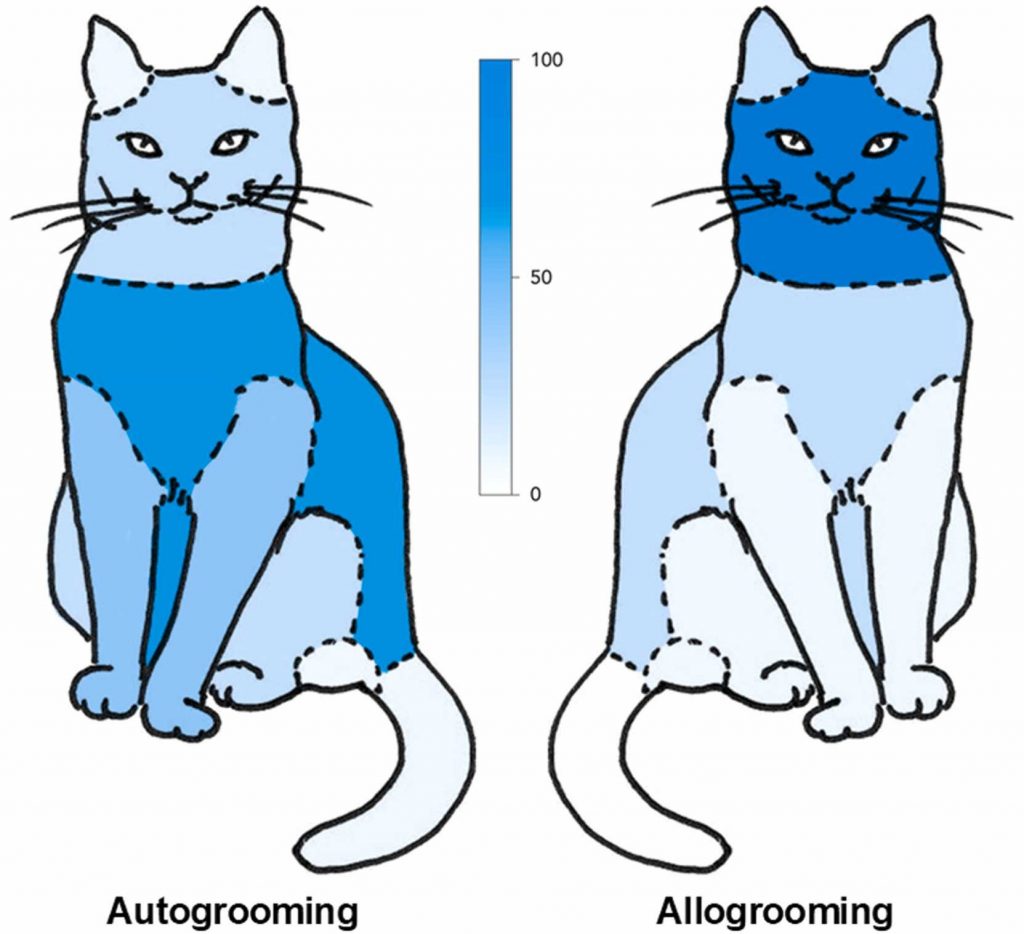
Body regions groomed by cats
Most cats groom another cat on the head, neck and ears. The further down the body you go, the less cats groom each other there, with just one instance of a cat grooming another cat’s booty. On the other hand, when cats groom themselves, they spend more time on the torso and legs. This image shows you where cats tended to groom depending on if they were grooming themselves or another cat (courtesy of the authors).
Behaviors that happen alongside allogrooming
Different behaviors that occurred with allogrooming tended to be associated with one another. For example, staring, wrestling, rotated ears and tail moving were closely related, suggesting a proportion of cats who were grooming in the context of fighting or possibly playing. Some cats rotated their ears while sniffing, without wrestling or tail movements, suggesting grooming with some social tension (but no fighting). Cats who were less likely to move away from each other and “huddle” also showed were more likely to groom themselves in addition to grooming the other cat.
Cat characteristics related to grooming
Turns out, some cats loooove to groom! Of the 106 cats represented in the study, 60 were classified as “groomers” and 40 as “groomees” (receivers of grooming). There was very little mutual grooming between cats. Groomers spent more time grooming both the other cat and themselves! Groomers also did more sniffing. Of the cats represented in the study, 29 pairs were related or met each other when young, and 24 pairs did not.
Explanations for grooming between cats
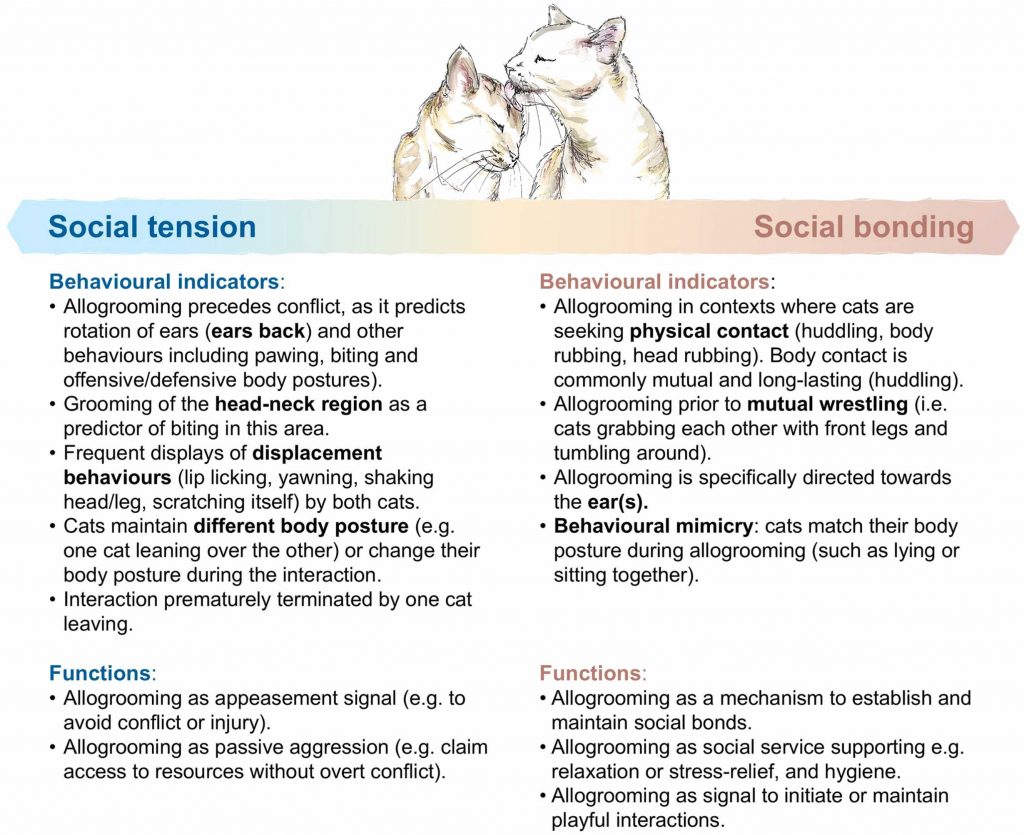
Allogrooming may serve multiple functions – but seems to be associated with two specific contexts:
- Tension between the cats (which sometimes includes fighting)
- Affection
When there is tension between cats, yet you see allogrooming, there tends to be:
- ears back, suggesting irritation
- more sniffing
- grooming of the head and neck that leads to biting in the area
- behaviors that indicate discomfort such as yawning and lip licking
- different body postures (e.g., one cat stands leaning over the other) or there is movement, such as the groomee changing posture
When cats are showing affection, there tends to be:
- Physical contact between bodies while the grooming happens
- Grooming is more focused on the ears
- The cats are often in synchrony, lying down or sitting together
Conclusions
Allogrooming CAN be a sign of friendship, but it’s highly likely that cats only showing one or two of the signs of friendship are not as close of friends as cats who show MORE of those behaviors. Grooming alone cannot be considered a reliable indicator of friendship between cats. Further, it is important to always look at the big picture as well as some of the micro-behaviors (such as ear movements and physical contact) associated with allogrooming to better understand the relationship between two cats.
Limitations
As always more research is needed. It would be helpful to observe multiple grooming bouts between the same pair of cats, to see if behaviors are consistent across grooming bouts. It is possible that people who are willing to take the time to submit videos of their cats interacting are different from other cat caregivers (or that their cats get along better, etc.) which could bias the results. However, this study is a very nice addition to our understanding of cat social behavior and just how complex it can be!
References
Crowell-Davis, S. L., Curtis, T. M., & Knowles, R. J. (2004). Social organization in the cat: a modern understanding. Journal of feline medicine and surgery, 6(1), 19-28.
Van Belle, M. J., Moons, C. P., Mills, D. S., Broeckx, B. J., Tuyttens, F. A., & Kmecová, N. G. (2026). Unravelling feline social dynamics-A video-based observational study on allogrooming in domestic cats. Applied Animal Behaviour Science, 107038.
van den Bos, R. (1998). The function of allogrooming in domestic cats (Felis silvestris catus); a study in a group of cats living in confinement. Journal of Ethology, 16(1), 1-13.

Terrific blog. Must now check my website to see if I need to rewrite anything.
I am pretty sure my cats’ allogrooming behavior scales on the “social tension” end every time I’ve seen them allogrooming. Does this mean they aren’t “friends”? They cohabitate pretty well, but once every blue moon the younger one sometimes will get a weird “prey drive” focus on the older one which results in the older one screaming and hissing. They do play well together though and take turns with toys when we’re playing as a “group” if that makes sense! Lots to think about. Thanks for the article!
I think some cats are more “roommates” than friends, but there are lots of factors to look at, not just grooming. And I think even friends can have the occasional spat!
I had always assumed allogrooming simply meant two cats were bonded, so it is interesting that a new study questions that. My two groom each other and then squabble five minutes later, which fits the idea that it is not that straightforward.